
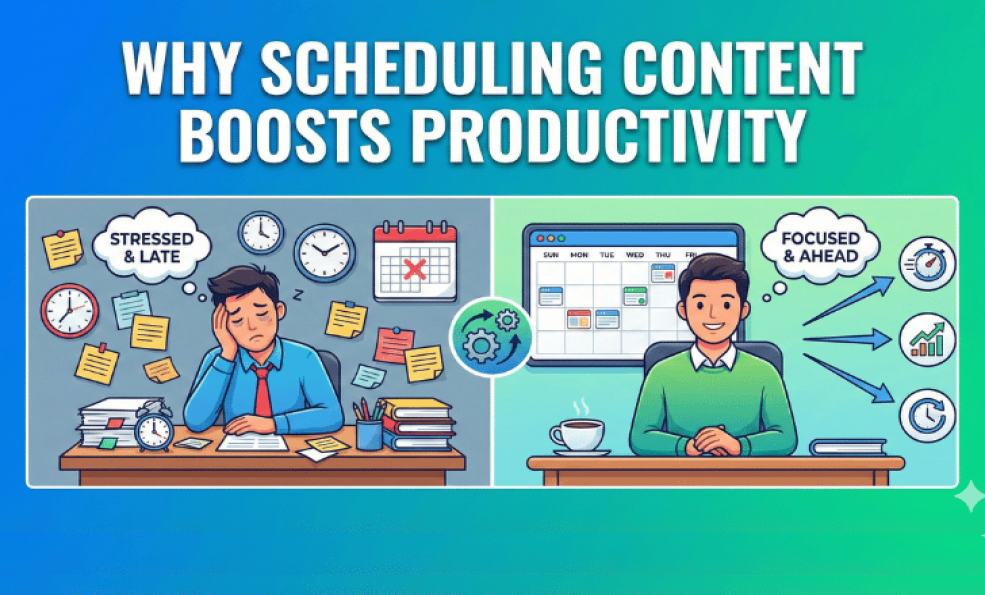
Why Scheduling Content Boosts Productivity
You're sitting down to work on something important. Something that requires deep focus. Something that moves your business forward. And then your phone buzzes. A social media notification. You need to respond to a comment. You need to check if your post is performing. Just thirty seconds. Just a quick check.
Scheduling content removes the pressure of daily posting and replaces it with clarity and control.
Thirty seconds becomes five minutes. Five minutes becomes fifteen. Suddenly, an hour has passed and you haven't accomplished the important thing you sat down to do.
This is the reality for most business owners and content creators. Social media isn't a task they do at a specific time. It's an interrupt that pops up throughout the day. And interrupts are devastating for productivity.
Here's the frustrating part: it doesn't have to be this way. The solution has existed for years. Scheduling content. But most people don't use it effectively, so they don't experience the productivity boost it creates.
When you actually use content scheduling properly, you get something powerful: deep work blocks where you're not interrupted. You get time to focus on strategy instead of mechanics. You get predictable content output without the constant context switching. You get your life back.
Key Takeaways
- Content scheduling reduces daily context switching by 80 percent
- Batching content creation saves 3 to 5 hours per week for most creators
- Strategic scheduling increases content consistency, which boosts reach by 40 percent
- Morning productivity increases by 60 percent when social media isn't an interruption
- Scheduled posting allows for strategic timing without manual monitoring
- Content batching improves content quality because you enter a creative flow state
- Time blocking for content frees up energy for higher-value activities
- Teams using content scheduling report 50 percent faster project completion
the Productivity Problem with Social Media
Before we talk about solutions, let's understand the problem that social media creates for productivity.
The Interruption Trap
Social media is designed to interrupt you. Notifications, messages, comments, trending topics. Every platform is engineered to pull your attention away from whatever you're doing.
Most people try to manage this by "checking" social media multiple times throughout the day. A quick check in the morning. A check after lunch. A check before bed. A quick check while waiting for a meeting.
But here's the problem: there's no such thing as a quick check. Your brain doesn't instantly jump into deep focus after you stop checking social media. There's a residual distraction effect. You checked one comment, but your brain is still partially thinking about the other responses you saw.
Research on context switching shows that it takes an average of 23 minutes to refocus on a task after an interruption. So a five minute social media check costs you 28 minutes of productivity. That's the time it takes to notice a notification, check it, and then refocus.
If you're doing this six times per day, you're losing over 2.5 hours of productivity daily. That's not a small thing. That's the difference between having time to focus on growth and constantly feeling like you're just keeping up.
The Energy Cost of Constant Decision Making
Social media doesn't just interrupt your time. It interrupts your mental energy.
Every time you log in, you face a thousand small decisions. What should I post? When should I post it? Is this good enough? Should I respond to this comment? Should I engage with that account? What hashtags should I use? What caption should I write?
These aren't complex decisions individually. But collectively, they're depleting. Psychologists call this decision fatigue. The more small decisions you make, the worse you become at making big decisions.
If you're making content decisions throughout the day, you're using up mental energy that should be going toward strategy, business growth, and actual thinking.
Content scheduling eliminates this. You make all your content decisions during a dedicated planning session. Then you stop making decisions about social media for the rest of the week.
The Myth of Real Time Engagement
There's a myth that you need to be actively managing social media in real time. That you need to post as inspiration strikes. That you need to respond to comments immediately. That you need to be constantly present.
This myth costs creators and businesses massive amounts of productivity.
Here's the reality: being present in real time doesn't actually increase engagement that much. What increases engagement is consistent, valuable content. It's responding to comments within a reasonable timeframe. It's being strategic about when you post. None of that requires you to be constantly glued to your phone.
Most successful creators and businesses don't manage social media in real time. They batch their content. They schedule their posts. They respond to comments during designated times. They've realized that presence matters less than consistency.
How Content Scheduling Works
Let's talk about what content scheduling actually is and how it changes your workflow.
The Traditional Workflow
The traditional workflow is reactive. You think of a post idea. You create the post. You post it immediately. You monitor it for a bit to see how it performs. Maybe you respond to comments as they come in.
This workflow is what creates interruptions and context switching. You're doing content work whenever the idea strikes or whenever it's time to post. There's no dedicated time. It's scattered throughout your day.
The Scheduled Workflow
The scheduled workflow is intentional. You have a dedicated time for content creation. Maybe it's Monday mornings. You create multiple posts. You review them. You schedule them to publish throughout the week at optimal times. Then you're done with content creation until the next Monday.
You respond to comments during designated times, maybe morning and evening. You track performance during a weekly analytics review. But the random social media interruptions throughout the day are gone.
The difference is massive. Instead of social media interrupting you dozens of times per day, you interact with it twice: once during creation and once during response time.
Batching and Flow State
One of the biggest benefits of scheduling is that it allows batching. Batching is when you group similar tasks together.
Instead of creating one post Monday, another Thursday, and another Saturday, you create five posts on Monday. You enter a creative flow state. Your brain gets into content creation mode. You think of ideas. You build on those ideas. You create better content because you're in flow.
When you create one post at a time, scattered across the week, you never enter flow state. You're constantly context switching between content creation and other work. The quality suffers. The speed suffers. The energy drain is worse.
Batching eliminates this. You create multiple pieces at once. You enter flow. You create better content faster. You're done with content for a week.
The Productivity Benefits of Content Scheduling
Let's look at specific ways that content scheduling boosts productivity.
Reclaiming Deep Work Time
The primary benefit is time. Content scheduling gives you back focused time blocks where you're not interrupted by social media.
If you're spending two hours per day on social media related tasks scattered throughout the day, that's devastating for deep work. You can't focus for more than twenty minutes before an interruption pulls you away.
But if you batch all that work into two hours on Monday morning, you've freed up the rest of the week for deep work. You have full afternoons where social media isn't interrupting you. You can focus on business strategy. You can focus on client work. You can focus on important tasks.
Most business owners report that this alone increases their productivity by 30 to 50 percent. They have actual focused time blocks again.
Consistency Creates Momentum
Scheduled content is consistent content. And consistent content performs better on social media algorithms.
Algorithms reward consistency. If you post sporadically, the algorithm doesn't know to favor your content. But if you post consistently at optimal times, the algorithm learns that your content is reliable. It starts pushing your content to more people.
This increased reach from consistency means you're building audience and engagement with less total effort. You're working smarter, not harder.
Reduced Decision Fatigue
Making all your content decisions during one dedicated session instead of throughout the day reduces decision fatigue.
During your Monday content creation session, you're in decision making mode. You make all the content decisions at once. Creative decisions, timing decisions, platform decisions. All at once, then you stop.
For the rest of the week, you're not making content decisions. This preserves mental energy for other important decisions in your business.
People who report this benefit say they have more energy for strategic decisions by Friday. They're not burnt out from making tiny decisions all week.
Organized Workflow
Scheduling requires organization. You have to plan what you're posting. You have to think ahead. You have to have a system.
This organization itself is a productivity boost. You're not frantically searching for ideas when it's time to post. You've already planned. You know what's going out. You know when. You know why.
A clear workflow is always more productive than a chaotic one.
Ability to Post at Optimal Times
Different times of day are better for reaching your audience. But you can't always be available to post at the optimal time.
Content scheduling solves this. You create the post whenever. You schedule it to post at the optimal time. The post goes out at the right time automatically, without you being there.
This means more people see your content at the time they're most likely to engage. It increases performance without increasing your effort.
Less Mental Load
When you're not constantly thinking about social media, your overall mental load decreases.
You're not worried about whether you've posted recently. You're not thinking about what to post next. You're not second guessing whether you responded to comments. The system is handling it.
This mental load reduction is invisible but powerful. You have more psychological energy for other things.
Strategy for Maximum Productivity
Let's talk about the specific strategy that creates the biggest productivity boost: batching.
Why Batching Works
Batching works because it allows flow state. Flow is when you're completely focused on a task and time disappears. You're creating content and ideas just flow. This is when your best work happens.
Flow state is impossible when you're scattered. Impossible when you're interrupted. Possible when you dedicate a focused block of time to one type of task.
Content batching leverages flow state. You create multiple posts at once. You're in content creation mode. Ideas build on each other. You create more content faster and with higher quality.
The Weekly Batching Model
Here's a practical model that works for most creators and businesses:
Set aside four hours on Monday morning for content creation. During these four hours, you create all your content for the week. You brainstorm ideas. You write captions. You select or create visuals. You schedule everything.
For the rest of the week, you're not creating new content. You're responding to comments and monitoring performance during designated times. But you're not creating.
This model gives you:
- Deep focus time during content creation
- No interruptions the rest of the week
- Consistent content output
- Flow state during creation
- Time for other work
The Bi-Weekly Batching Model
Some people prefer less frequent batching. You could create two weeks of content every other Monday.
This takes longer (maybe six to eight hours) but you only do it twice per month. The rest of the time you're not thinking about content creation at all.
The trade off is that you need more advanced planning. You need to think about what you're posting two weeks from now. But the reward is that you have even more uninterrupted time.
The Monthly Batching Model
For larger teams or agencies, monthly batching can work. You have one day per month where you create all your content for the month.
This requires more planning but it's the ultimate productivity boost. Teams report that moving to monthly batching freed up so much time that they could expand to new clients or new services.
How Scheduling Changes Your Daily Routine
Let's look at how content scheduling actually changes what your day looks like.
Before Scheduling
A typical day without scheduling looks like this:
8 AM: You check your notifications. A few comments came in overnight. You respond to them. While you're there, you check your feed. Someone posted something relevant to your niche. You engage with it. Before you know it, thirty minutes have passed.
10 AM: You're in a meeting. Your phone buzzes. A comment on your post. You check it quickly. The meeting is disrupted.
12 PM: You think of a post idea. You open your phone and start creating it. It takes forty five minutes. You finally post it.
2 PM: You check how the post is performing. Not great yet. You're disappointed. You tell yourself you'll check again in an hour.
3 PM: You check again. A few more engagements. You respond to comments.
5 PM: You're trying to focus on important work but you keep thinking about whether you should post again today.
By the end of the day, you've spent over three hours on social media scattered across your day. You never had a real deep work block. You're tired from context switching. Your important work didn't get the focus it deserved.
After Scheduling
A typical day with scheduling looks like this:
Monday 8 AM to 12 PM: Content creation and scheduling. You're in full content mode. You create multiple pieces. You batch your work. You schedule them throughout the week. You're done until Thursday.
Thursday 10 AM: You respond to comments from the week. It takes thirty minutes.
Friday 4 PM: You check analytics and plan next week's content. One hour.
Tuesday, Wednesday, Thursday afternoons: You have full focus blocks. No interruptions from social media. You do your real work.
By the end of the week, you've spent maybe five hours total on social media. But your content has been consistent. It posted at optimal times. And you had multiple full days of deep focus.
The difference in what you can accomplish is enormous.
Content Scheduling and Different Business Models
Different business models benefit from scheduling in different ways.
Solo Entrepreneurs and Freelancers
For solo operators, scheduling is essential. You don't have time to manage social media in real time and do your actual work.
Scheduling lets you handle social media efficiently in a couple of hours per week while dedicating the rest of your time to client work or product development.
Small Business Owners
For small businesses, scheduling lets you maintain a consistent social presence without it becoming a full time job.
You can post daily across multiple platforms without spending hours daily on social media. The consistency builds reach. The scheduled approach saves time.
Content Creators and Influencers
For creators, scheduling lets you batch creation into flow states. You can create weeks of content in one dedicated session.
This is how creators maintain consistency and quality while still having time for other things.
Agencies and Teams
For agencies managing multiple clients, scheduling is a force multiplier. You can create content for all clients in batch sessions. You can scale your team's output without scaling your team size.
The Tools That Make Scheduling Effective
Content scheduling is only as effective as the tools you use.
Unified Scheduling Dashboards
The best approach is using a unified dashboard where you can schedule content to multiple platforms at once. Instead of going platform by platform, you create once and publish everywhere.
This alone saves significant time. You're not managing five separate scheduling interfaces.
Queue and Optimal Time Features
Some tools can queue your content and automatically post at optimal times for your audience. You create and queue. The system posts when your audience is most active.
This removes the need to manually figure out posting times.
Content Calendar Views
A calendar view of your scheduled content helps you see your posting schedule at a glance. You can see what's coming, avoid repetition, and maintain good spacing.
Batch Creation Features
The best tools for batching let you create multiple pieces quickly. Templates, content suggestions, media libraries. Everything organized to help you create faster.
Analytics Integration
When your scheduling tool integrates with analytics, you can see performance data right in the scheduling interface. You learn what works for your audience without jumping between tools.
Conclusion: Reclaim Your Time
Content scheduling isn't a new idea. It's been available for years. But most people haven't grasped how powerful it is for productivity.
The reason is simple: they haven't experienced the difference. They haven't felt what it's like to have a full afternoon of uninterrupted deep work. They haven't experienced the mental energy of not constantly thinking about social media.
Once you experience it, you understand why scheduling is so powerful.
You get back time. You get back focus. You get back mental energy. You get consistency. You get better results from less effort.
The math is simple. Four hours of batched content creation per week, scheduled to post optimally, gives you the rest of the week free from social media interruptions. That's 35+ hours of reclaimed time per week.
Thirty five hours. That's transformative.
Start by choosing one week. Batch your content. Schedule it. Notice how much more focused you are the rest of the week. Notice how much more you accomplish.
Once you experience it, you'll never go back to the scattered, interrupt driven approach.
Your productivity is waiting on the other side of content scheduling.
Share This post
Recent Blog Post

How to Manage Multiple Social Media Accounts
06 Oct, 2025

Create Scroll-Stopping Social Media Posts With AI
06 Oct, 2025