

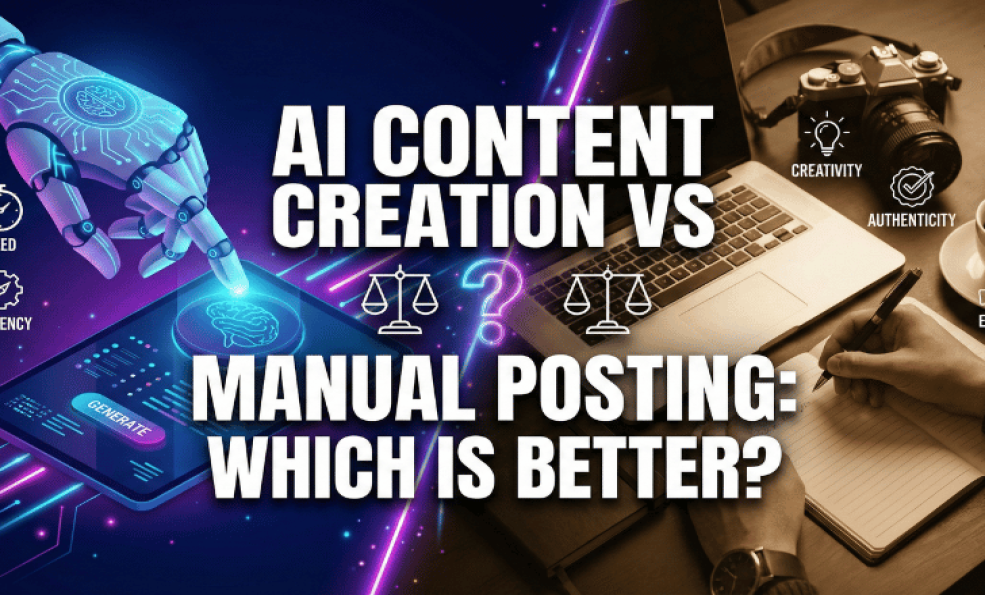
AI Content Creation vs Manual Posting: Which Is Better
There's a debate happening right now in social media circles, and honestly, it's a bit silly. On one side, purists insist that manual content creation is the only way to maintain authenticity. On the other side, efficiency advocates swear that AI is the future and manual posting is wasting time.
AI accelerates content creation, but human creativity gives it meaning. The best results come from using both together.
Both sides are kind of right. And both sides are missing the point.
The question isn't whether AI content creation or manual posting is better. The real question is which approach serves your specific business goals, timeline, and resources right now. And more importantly, why are we even pretending these are mutually exclusive options?
Here's what nobody talks about: the best strategy for most businesses isn't pure AI and it isn't pure manual. It's a hybrid approach that leverages both when it makes sense. But first, let's understand what we're actually comparing.
Key Takeaways
- AI content creation saves 70 percent of the time compared to manual posting
- Manual content maintains authenticity and personal connection that AI can't fully replicate
- The best approach for most businesses combines both AI and manual elements
- Cost per piece of content is 80 percent lower with AI tools
- Audience engagement doesn't significantly decrease with AI when done correctly
- Your industry, audience, and goals determine which approach works best
- The future isn't about choosing between AI and manual, it's about using both strategically
AI Content Creation
Let's start by defining what we mean by AI content creation, because it's become a catch-all term that can mean different things.
What AI Content Creation Actually Does
AI content creation tools don't necessarily create your content from scratch. The best ones work more like intelligent collaborators. You give them direction, and they generate options that you refine and personalize.
Here's how it actually works: You tell the AI that you want to create content about productivity tips for entrepreneurs. You specify that you want it to appeal to startup founders. You give it some context about your brand voice. The AI then generates five different content angles, multiple copy variations, and suggestions for visuals and captions.
You're not publishing the AI output directly. You're reviewing these options, choosing what resonates with you, customizing it, adding your personal touch, and then posting it. The AI accelerated the thinking and drafting phase. You added the authenticity.
This is fundamentally different from people's fear that AI will just spit out robotic content that gets posted as-is.
Advantages of AI Content Creation
Speed is the obvious advantage. What takes three hours to create manually might take twenty minutes with AI. This isn't hyperbole. The time savings are real.
But there are other advantages that are often overlooked. First, consistency. AI doesn't have bad creative days. It doesn't decide your content isn't good enough so it doesn't post. It generates reliably good options every single time you use it.
Second, volume. You can create more content in less time. And more content means more opportunities to reach your audience.
Third, variety. Good AI tools help you generate different angles and formats for the same core idea. So you're posting more frequently without repeating yourself.
Fourth, optimization. The best AI tools analyze your audience and suggest content variations optimized for your specific followers. They're not just generating generic content. They're tailoring suggestions to what actually works for your audience.
Fifth, consistency in quality. There's no mood affecting your content output. Monday's post is as good as Friday's post. Your audience gets reliable, quality content regardless of your energy level.
Limitations of AI Content Creation
Here's where we need to be honest: AI has real limitations.
First, it lacks genuine insight. AI can talk about a topic intelligently, but it doesn't have lived experience. It doesn't know what it's actually like to struggle with the problem your product solves. It can't tell a story from personal experience because it doesn't have experiences.
Second, it can sound generic if you don't direct it well. The best AI content is a collaboration. If you just use the default output without adding your perspective, it will sound like a thousand other AI-generated posts.
Third, it can hallucinate facts. It might generate something that sounds credible but is actually incorrect. You still need to fact check, especially for industry-specific or technical content.
Fourth, it misses cultural nuance. AI might miss local references, current events, or subtle cultural context that resonates with your specific audience.
Fifth, it requires skill to use well. Just like a camera doesn't make you a photographer, an AI content tool doesn't make you a good content creator. You still need to know what makes content good and how to direct the tool effectively.
Manual Content Posting
Now let's look at the other side: manual content creation and posting.
What Manual Content Creation Actually Means
Manual posting is straightforward. You write the content yourself. You create or select the visuals yourself. You post it yourself. You respond to comments yourself. You do all of it without AI assistance.
This is the traditional approach that has worked for years. It's what most successful content creators built their audiences on before AI tools existed.
Advantages of Manual Content Creation
Authenticity is the primary advantage, and it's a real one. When you create content from your own perspective and experience, people can feel that authenticity. There's a genuineness that comes from a real person sharing real insight, not an AI synthesizing information.
Personal connection is another advantage. Your audience connects with you as a person, not with a brand. When people see your unique voice and personality in your content, they engage differently. They feel like they know you.
Flexibility is a third advantage. You can adapt in real time. You see something relevant happening, and you can immediately create content around it. You don't have to wait for AI to generate options or templates. You just create.
Trust is a fourth advantage. Many audiences specifically value human-created content. If you tell them you created the content, they trust it more. Some people see AI content as inherently less trustworthy, even if it's good.
Depth of knowledge is a fifth advantage. You understand your audience in a way AI doesn't. You know the questions they ask. You understand their objections. You can address their specific needs with nuance.
Limitations of Manual Content Creation
Time is the obvious limitation. Creating content manually is slow. Ideation takes time. Writing takes time. Creating or finding visuals takes time. That's why many businesses struggle with consistency.
Consistency is the second limitation. Because it's time consuming, many people post inconsistently. They post a lot one week and nothing the next. This actually hurts your reach because algorithms reward consistency.
Cost is a third limitation. If you're not creating content yourself, you're hiring someone. A full time content creator costs money. Multiple content creators cost even more money.
Limited output is a fourth limitation. One person can only create so much content. If you want to maintain presence on five platforms with consistent posting, that's a lot of content. Manual creation can limit how much you can realistically produce.
Mental exhaustion is a fifth limitation. Creating original content constantly is mentally taxing. Creative energy has limits. Many creators hit a wall where they just don't want to create anymore.
Head to Head Comparison
Let's directly compare these approaches across different dimensions.
Time Investment
AI content creation wins decisively here. For creating five social media posts per week, manual creation might take fifteen to twenty hours per week. With AI, it might take five to seven hours per week including the time to personalize and refine AI output.
But this varies by quality standards. If you're willing to post lower quality content manually, you might save time. If you're perfectionistic about AI content, you might spend more time refining than you would have creating manually.
The time savings are real though, especially for creating content across multiple platforms.
Quality of Content
This is more nuanced than people think. The best manually created content is probably better than the best AI created content because it has genuine human insight and perspective.
But the average manually created content isn't necessarily better than average AI created content. A tired creator posting mediocre content manually is worse than that same creator using AI to create better content with the time they saved.
Quality is about what the human brings to the process. If you're using AI just to output content as-is without refinement, the quality suffers. If you're using AI as a tool to help you create better content faster, the quality improves.
Authenticity and Trust
Manual content wins here. People can tell when content comes from a real person with genuine experience. That authenticity builds trust.
AI content can be good and can build trust, but it requires the human element to feel authentic. The AI generates the outline, but you personalize it. The AI generates copy options, but you add your voice. Pure AI output without human refinement will always feel less authentic.
Consistency and Volume
AI wins decisively. You can post more frequently with AI. You can maintain consistent presence across multiple platforms. You can keep your audience engaged with regular content.
Manual posting often leads to inconsistent schedules. You post heavily when you have time and energy, then disappear for a while.
Algorithms reward consistency. From a pure reach and engagement perspective, frequent consistent posting beats sporadic manual posting.
Cost Per Post
AI is dramatically cheaper. A single post created manually might cost you thirty dollars in your time or might cost you money if you hire someone. A post created with AI might cost you a few cents in tool subscription divided across your posts.
If you're a large brand creating lots of content, this difference compounds into thousands of dollars per month.
Audience Response
Here's where it gets interesting. When you compare similarly good manually created content to similarly good AI created content, audience response is basically equivalent.
But the caveat is important: the quality has to be similar. A great manual post outperforms an okay AI post. But an okay manual post doesn't necessarily outperform a great AI post.
This tells us that quality matters more than whether it was created by AI or manually. A post is good because it's relevant, well written, and valuable. Not because of the method used to create it.
Which Approach Works Best
Different situations call for different approaches.
Scenario: You're a Solo Creator With Limited Time
In this case, AI is probably the right choice. You have limited hours to dedicate to content creation. Without AI, you either post inconsistently or burn yourself out trying to keep up.
With AI, you can create consistent, high quality content in the time you have available. You spend less time on mechanics and more time on strategy and audience connection.
The trade off is slightly less personally authentic content. But consistency and quality probably matter more than perceived authenticity in this scenario.
Scenario: You're Building Personal Brand
In this case, manual creation is probably better. Your audience is following you for your specific insights and perspective. They want to hear from you, not from an AI trained on general information.
But even here, a hybrid approach makes sense. Manual creation for your main content that demonstrates your unique insights. AI for supporting content like resharing or expanding on ideas you've already covered.
Scenario: You're Managing Content for Multiple Brands
This is where AI shines. You can't manually create fresh, original content for five different clients while maintaining quality. But with AI, you can generate multiple pieces per client per week, customize them to each brand voice, and maintain quality across all accounts.
The time savings enable you to serve more clients or focus on strategy instead of execution.
Scenario: You're Operating a Large Social Media Team
In this case, hybrid absolutely makes sense. Your team creates the core strategic content manually. Then AI tools help them create supplementary content, adapt content for different platforms, and handle routine content needs.
AI becomes a force multiplier for your team. They create better work because they spend less time on mechanics.
The Hybrid Approach:
Here's what we're learning from brands and creators doing this well: the optimal approach combines AI and manual creation strategically.
How to Build a Hybrid Content Strategy
Start with your core content. This is the content that demonstrates your unique value and perspective. Create this manually. Spend the time. Add your genuine insight. This is where your authenticity comes through.
Then use AI for supporting content. You share a case study manually. You use AI to create a breakdown post expanding on the key points. You write a detailed guide manually. You use AI to create summary posts highlighting different sections.
Use AI to adapt your content across platforms. You create one comprehensive piece. AI adapts it for Instagram, LinkedIn, TikTok, Twitter. You review and personalize. You post to all platforms.
Use AI for routine content. Weekly tips. Quick insights. Updates. These don't require your unique perspective. Let AI generate them. You review for quality and brand alignment. That's it.
The result is consistent, high quality content that includes your authentic voice and insights while maintaining reasonable time investment.
The 80/20 Rule for Hybrid Content
Here's a practical framework: 20 percent of your content should be your core authentic content that demonstrates your unique perspective. 80 percent can be supporting content that is good quality but doesn't necessarily require your unique voice.
This framework means you're showing your authentic self and building genuine connection with your audience. But you're not trying to manually create everything, which is unsustainable.
The 20 percent of authentic content builds the connection and trust. The 80 percent of AI enhanced or generated content maintains visibility and consistency.
Conclusion
The question of AI versus manual content creation is asking the wrong thing. It's not either or. It's both, used strategically.
The businesses and creators winning in 2025 are those who understand that AI is a tool to augment human creativity, not replace it. They create their core authentic content manually. They use AI to create more content, adapt it across platforms, handle routine updates, and maintain consistency.
This approach gives them the authenticity that builds trust, the consistency that drives reach, and the efficiency that lets them focus on strategy and real audience connection.
If you're currently doing everything manually and feeling burnt out, try adding AI for supporting content. If you're currently using AI exclusively and worried your content lacks personality, add manual creation for your core content.
The future of social media content isn't about which method is better. It's about being smart enough to use each method where it serves your goals best.
Start there, and you'll find your optimal balance.
Share This post
Recent Blog Post

How to Manage Multiple Social Media Accounts
06 Oct, 2025
Why Scheduling Content Boosts Productivity
06 Oct, 2025
Create Scroll-Stopping Social Media Posts With AI
06 Oct, 2025