
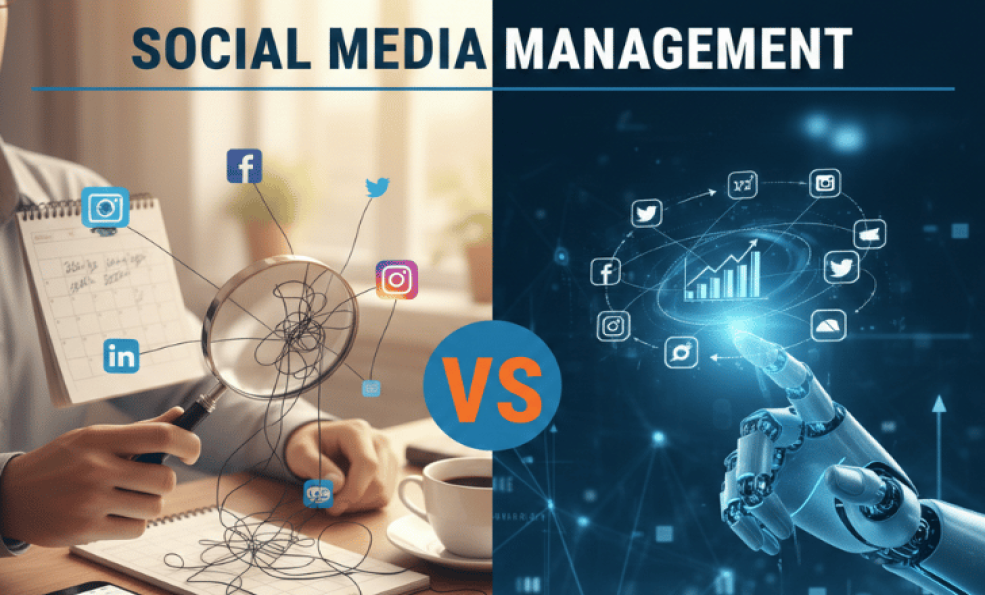
Manual Social Media Management vs AI Tools: A Comparison
You're sitting in a meeting deciding how to handle social media for your business. One option is obvious: hire someone to manage it manually. They'll post, engage, respond. It's the traditional approach. It's how successful brands built their social presence.
“Manual management brings a human touch, while AI tools deliver speed and scale. The real advantage comes from knowing when to use each.”
The other option is newer: use AI tools to automate and accelerate the process. Let machines handle the routine work. Focus humans on strategy. It's the future, right?
But here's what makes this decision difficult: both approaches actually work. Brands have built massive audiences and loyal communities with purely manual management. Other brands have achieved similar results with AI tools. Some combination of both.
The question isn't which one is objectively better. The question is which one is better for your specific situation, your budget, your goals, and your constraints.
Understanding the real differences between manual management and AI tools is the first step to making a smart decision. And it's more nuanced than most people realize.
Key Takeaways
- Manual management builds authentic relationships but costs 5 to 10 times more than AI tools
- AI tools save 70 percent of time but require strategy to feel authentic
- Manual management can't scale easily while AI scales almost infinitely
- AI tools work best when combined with human strategy and oversight
- The best approach for most businesses is hybrid, not purely one or the other
- Manual management excels at real time adaptation while AI excels at consistency
- Cost per post is 80 percent lower with AI tools versus hiring humans
- Teams using hybrid approaches report highest satisfaction and results
Manual Social Media Management
Let's start by looking at what manual management really means and how it works.
What Manual Management Actually Is
Manual social media management means a human is doing all the work. They're creating content. They're scheduling posts. They're monitoring engagement. They're responding to comments and messages. They're analyzing performance. They're developing strategy.
This could be you doing it yourself, or it could be hiring someone dedicated to this role.
Advantages of Manual Management
The biggest advantage of manual management is authenticity. A real human creating content from genuine perspective and experience brings authenticity that's hard to replicate.
When someone on your team is creating content, they understand your business deeply. They've heard customer questions. They've solved problems. They can share stories and insights that come from real experience. This authenticity builds trust.
The second advantage is real time adaptation. If something is happening in your industry right now, a manual manager can create content about it immediately. They can respond to trends. They can adapt based on what's working in the moment.
The third advantage is genuine engagement. Real humans connecting with other humans creates a different type of relationship than automated systems can. People feel the difference between talking to a person and talking to a bot.
The fourth advantage is relationship building. Your team member actually knows your audience. They remember who asks good questions. They build genuine relationships over time. These relationships lead to loyalty and community.
Disadvantages of Manual Management
The biggest disadvantage is cost. A full time social media manager in the US costs between thirty five and sixty thousand dollars annually. Plus benefits. Plus ongoing training. For a small business, this is often impossible.
If you outsource to an agency, the cost is even higher. Agencies typically charge one thousand to five thousand dollars per month depending on the scope of work.
The second disadvantage is time. Manual content creation takes significant time. Good content can't be rushed. You're looking at five to fifteen hours per week of dedicated social media work for decent output.
The third disadvantage is consistency. A single human has limitations. They have good days and bad days. They have energy and they have burnout. This affects the consistency of content and engagement.
The fourth disadvantage is limited output. One person can only create so much content. If you want to maintain presence on five platforms with daily posts, that's a lot of work. One person reaches capacity quickly.
The fifth disadvantage is lack of scalability. If you want to double your social media output, you need to double your team. This adds cost and complexity.
AI Tools for Social Media Management
Now let's look at what AI tools can actually do.
What AI Tools Actually Do
Modern AI tools don't replace humans entirely. They accelerate and automate specific tasks. Content generation, scheduling, analytics analysis, trend identification, engagement suggestions.
The most effective AI tools are collaborative. They work with human input and decision making. You tell them what you want. They generate options. You refine and decide.
Advantages of AI Tools
The biggest advantage is time savings. What takes hours manually can take minutes with AI. Content creation, scheduling, analytics review. All significantly faster.
The second advantage is consistency. AI doesn't have bad days. It doesn't get tired or burnt out. You get consistent content output regardless of human energy levels.
The third advantage is cost. AI tools typically cost between five hundred and three thousand dollars annually per user. This is 90 percent cheaper than hiring a full time person.
The fourth advantage is scalability. You can post to five platforms as easily as one. You can create multiple pieces in the time it used to take to create one. Your output can scale without proportional cost increase.
The fifth advantage is data based optimization. AI tools analyze your performance and suggest improvements. They learn what works for your specific audience and get better over time.
The sixth advantage is 24/7 availability. Content scheduling means your posts can go out at optimal times even if you're sleeping. Your social media doesn't stop when you log off.
Disadvantages of AI Tools
The biggest disadvantage is that it requires skill to use well. An AI tool in the hands of someone who doesn't know how to direct it, fact check it, or personalize it will produce mediocre results.
The second disadvantage is that pure AI output can feel generic. If you just use the AI's default suggestions without adding human perspective, the content lacks personality and authenticity.
The third disadvantage is that AI can make mistakes. It might generate something that sounds credible but is actually incorrect. You still need human review and fact checking.
The fourth disadvantage is that it misses cultural context. AI might not understand local nuances, recent events, or subtle cultural references that matter to your specific audience.
The fifth disadvantage is that some audiences have bias against AI content. If your audience finds out you're using AI, some might feel less connected or trustworthy.
Side by Side Comparison
Let's directly compare these approaches across the most important dimensions.
Cost Comparison
This is where the difference is most dramatic.
Hiring a full time social media manager costs thirty five thousand to sixty thousand dollars annually. Add benefits, taxes, training. You're looking at fifty thousand to seventy five thousand dollars total cost.
Using an AI tool costs five hundred to three thousand dollars annually. That's 95 percent cheaper.
Even if you hire an agency at two thousand dollars per month, that's twenty four thousand dollars annually. Still much more expensive than AI tools.
For a small business with limited budget, this cost difference is often decisive.
Time Investment Comparison
Manual management requires five to fifteen hours per week depending on the scope and quality standards.
AI assisted management requires two to five hours per week for similar output. The AI handles creation, scheduling, and some analytics. You handle strategy, personalization, and quality review.
Pure AI automation with minimal human oversight might take thirty minutes per week, but the quality usually suffers without human direction.
Quality Comparison
The best manually created content is probably better than the best AI created content because it has genuine human insight and lived experience.
But average manually created content isn't necessarily better than average AI created content. A tired manager creating mediocre posts manually is worse than that same person using AI to create better posts with the time they save.
Quality depends more on how you use the tool than which tool you use.
Authenticity and Trust
Manual content from real humans builds more authentic trust. People can feel the difference between a real person and a machine.
But AI content can feel authentic when a human adds their perspective and voice to it. The AI creates the foundation. The human adds authenticity.
Pure AI output without human touch feels generic. But AI output with human refinement feels personal.
Consistency and Volume
AI wins decisively here. You can maintain consistent posting schedules across multiple platforms without the content suffering.
Manual management often leads to inconsistent posting because one human can only do so much. Consistency suffers when you're trying to manage five platforms manually.
Real Time Responsiveness
Manual management wins here. Your team can respond to trends and opportunities in real time.
AI tools are better at scheduled, consistent content. They're not as good at jumping on timely opportunities.
Audience Engagement
Manual management creates more genuine engagement because real humans are interacting with real humans.
AI can help manage engagement at scale, but it lacks the personal touch that creates deep connection.
Learning and Improvement
AI tools analyze your performance and learn what works for your audience. Over time, they get better at generating content that resonates.
Manual managers also learn from experience, but they rely more on intuition and memory.
Scaling Ability
AI scales easily. You can post to ten platforms as easily as one. You can double your output with minimal additional cost.
Manual management doesn't scale well. Doubling output means doubling your team, which doubles your cost.
Real World Scenarios: Which Approach Works Best
Different situations call for different approaches.
Scenario: Solo Entrepreneur With Limited Budget
In this case, AI tools are the clear choice. You don't have budget to hire someone. Doing everything manually is burning you out. AI tools let you maintain a professional presence without it consuming your entire life.
You use AI to create content, schedule it, and handle analytics. You spend maybe three hours per week and get consistent output. The cost is minimal.
Scenario: Large Brand With Large Team
In this case, you probably want both. Your team creates the core strategic content manually. Then AI tools help them create supplementary content, adapt content across platforms, and handle routine tasks.
The combination gives you the authenticity of human creation with the efficiency of AI tools.
Scenario: Personal Brand Building Audience
In this case, manual management might be better. Your audience is following you for your specific perspective. They want to hear from you directly. Using pure AI tools might feel impersonal.
But you could use AI to help with the mechanical parts while keeping the creative voice manual.
Scenario: Managing Multiple Client Accounts
This is where AI shines. You can't manually create fresh, original content for five different clients. But with AI tools, you can generate multiple pieces per client per week. You customize them to each brand voice. You maintain quality across all accounts.
The time savings enable you to serve more clients.
The Hybrid Approach: The Real Winner
Here's what's becoming clear in 2025: the businesses and creators seeing the best results aren't choosing between manual and AI. They're using both strategically.
How Hybrid Works
You use AI for things that don't require uniqueness. Content scheduling, analytics analysis, trend identification, content adaptation across platforms.
You use humans for things that require authenticity and strategy. Core content creation, real audience engagement, strategic direction.
The result is that you get the authenticity and relationship building of manual management with the efficiency and scalability of AI tools.
The Ideal Hybrid Model
Your best content is created manually. This is where your unique perspective shines. Maybe that's 20 to 30 percent of your content.
Supporting content is created with AI assistance. The AI generates options. You customize and personalize. Then post. This is 50 to 60 percent of your content.
Routine content is generated primarily by AI. Weekly tips, quick insights, updates. These don't require your unique voice. AI creates them. You review for quality and brand alignment. This is 20 to 30 percent of your content.
The result is a mix that feels authentic while being sustainable and scalable.
Why Hybrid Works Better
Hybrid works because it plays to the strengths of both approaches. You get the authenticity and relationship building that comes from human creation. You get the efficiency and scalability that comes from AI tools.
You're not sacrificing quality for speed. You're not sacrificing authenticity for efficiency. You're finding the balance.
Conclusion
The future of social media management isn't manual versus AI. It's figuring out how to use both effectively.
Manual management builds authentic relationships but doesn't scale. AI tools scale infinitely but require human direction to feel authentic. Together, they create something more powerful than either alone.
Your decision shouldn't be based on which approach is objectively better. It should be based on your specific situation. Your budget. Your team. Your audience. Your goals.
If you have limited budget and limited team, AI tools are likely the best choice. They give you professional results without breaking the bank.
If you have budget and team but need to scale, hybrid approach is likely the best choice. You get authenticity and efficiency.
If you're a massive brand with massive team, you probably use both extensively, with AI handling routine work and humans handling strategy and relationships.
The key is understanding what each approach does well and building a system that plays to those strengths.
Stop thinking about this as manual versus AI. Start thinking about how to use both in a way that serves your business and audience best.
That's the path to social media success in 2025.
Share This post
Recent Blog Post
How to Manage Multiple Social Media Accounts
06 Oct, 2025
Why Scheduling Content Boosts Productivity
06 Oct, 2025
Create Scroll-Stopping Social Media Posts With AI
06 Oct, 2025