

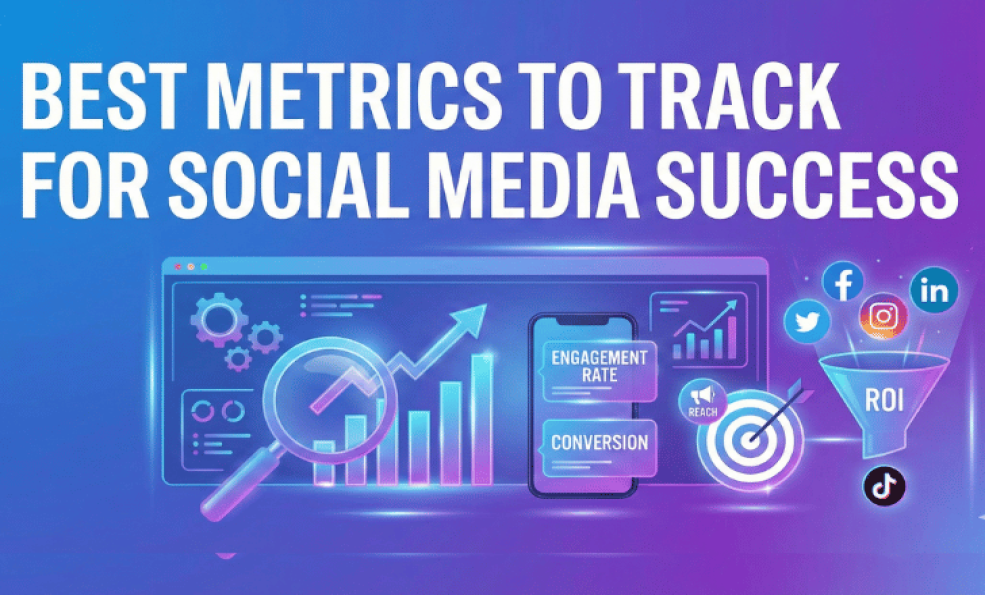
Best Metrics to Track for Social Media Success
It starts innocently enough. You post something. You get ten likes. That feels good. You post again and get fifteen likes. Better. Then someone likes your post a hundred times and suddenly you're obsessed.
You can’t improve what you don’t measure. Tracking the right social media metrics turns content into insights, and insights into real growth.
This is the moment social media metrics became toxic.
For years, the industry told us that likes, followers, and impressions were the markers of success. Post more, get more followers, get more engagement, win at social media. It's simple. It's measurable. It's completely misleading.
The problem is that these vanity metrics feel good but they don't actually tell you anything about whether your social media strategy is working. You could have ten thousand followers and zero conversions. You could get thousands of impressions and never convert a single person into a customer. You could go viral and still go out of business.
This is frustrating because it means most social media managers and business owners are measuring the wrong things. They're optimizing for metrics that don't matter while ignoring the metrics that actually drive business results.
Here's the truth: the best metrics to track aren't the ones that feel good. They're the ones that directly impact your business.
Key Takeaways
- Vanity metrics like follower count and raw likes don't correlate with business success
- Engagement rate matters far more than total engagement numbers
- Click through rate and traffic to your website are direct indicators of social media ROI
- Conversion metrics tell you if social media is actually generating revenue or leads
- Audience growth rate reveals whether your content strategy is actually resonating
- Save time tracking metrics with unified dashboards that compile data automatically
- The right metrics vary by your business goals, not by industry best practices
Why You're Tracking the Wrong Metrics
Let's start by acknowledging the elephant in the room. If you're measuring success primarily by follower count or total likes, you're chasing a metric that doesn't matter.
Here's why: A brand with fifty thousand followers and terrible engagement is less valuable than a brand with five thousand followers and amazing engagement. The fifty thousand follower brand has an audience that doesn't actually care. The five thousand follower brand has a community that's invested.
Which would you rather have?
Social media platforms built the follower system to keep you addicted, not to measure success. Every time someone new follows you, there's a little dopamine hit. You feel like you're winning. But a follower who never engages, never clicks through to your website, and never becomes a customer is literally worthless for your business.
The same goes for raw impression numbers. Your post was shown to fifty thousand people. Sounds great, right? Except forty-nine thousand of them scrolled right past it without stopping. One thousand saw it but didn't care. And you have no idea which one of them actually matters.
These metrics feel important, but they're what we call vanity metrics. They make you look good but they don't tell you anything useful about whether your social media strategy is actually working.
The good news is that tracking the right metrics is actually simpler than tracking vanity metrics. It just requires a shift in perspective.
Metrics That Actually Matter for Your Business
Let's talk about the metrics that genuinely indicate whether your social media efforts are moving the needle for your business.
Engagement Rate:
Engagement rate is different from total engagement. This is important.
Total engagement is just the sum of all your likes, comments, and shares. It sounds big and feels impressive. But engagement rate tells you the percentage of your audience that actually interacted with your content.
Here's why this matters: Imagine you posted to ten thousand followers and got one hundred likes. Your engagement rate is one percent. Now imagine you posted to five thousand followers and got one hundred fifty likes. Your engagement rate is three percent. The second post performed three times better, even though the first post got more total engagement in raw numbers.
Engagement rate is what you should be tracking. It tells you whether your content is actually resonating with your audience. It's consistent across different sized accounts. It shows real impact.
A healthy engagement rate varies by platform and industry, but generally anything above two percent is solid. Above five percent is excellent. If your engagement rate is consistently below one percent, your content isn't connecting.
How do you improve it? By posting content that your specific audience actually cares about. More authentic content. More conversation-starting content. Less generic, everybody posts this kind of content.
Click Through Rate:
Here's something most social media managers ignore: click through rate.
Click through rate is the percentage of people who see your post and actually click the link you included. It's simple. It's measurable. And it tells you directly whether your social media is driving traffic to where you actually need it.
Why does this matter? Because clicks are what convert to revenue. A social media post that gets ten thousand impressions but zero clicks is completely useless. A post that gets one thousand impressions and fifty clicks is far more valuable.
Click through rate is usually expressed as a percentage. You got one hundred clicks from a post that was shown to five thousand people. Your CTR is two percent. That's pretty good.
When you're tracking this, look at what drives better click through rates. Is it certain types of content? Certain calls to action? Certain times of day? Start noticing patterns. The content that gets clicks is the content that matters to your business.
For many businesses, CTR is more important than engagement rate because clicks lead to conversions. You want people not just engaging with your content, but actually taking action.
Website Traffic from Social
This is where the rubber meets the road.
How much traffic is social media actually driving to your website? Not impressions. Not clicks on the post itself. Actual visits to your website.
You can track this through Google Analytics. Set up UTM parameters on your social media links so you can track exactly how much traffic each platform is driving. You'll see that Instagram is driving three hundred visits per week, LinkedIn is driving one thousand, and TikTok is driving barely anything.
This metric tells you which platforms are actually valuable for your business. Some businesses will find that LinkedIn is their goldmine. Others will find that Instagram drives way more traffic than expected. You can't know until you measure it.
More importantly, this metric helps you decide where to focus your effort. If TikTok is driving almost no traffic, maybe you shouldn't be spending hours creating TikTok content. Maybe you should double down on LinkedIn where you're actually seeing results.
Conversion Rate:
Here's the uncomfortable truth: everything else is secondary to this one metric.
Conversion rate is the percentage of people who click through from social media and actually take the action you want them to take. Maybe that's making a purchase. Maybe it's signing up for your newsletter. Maybe it's filling out a contact form. Whatever your actual business goal is.
Everything else is just the path to this metric.
A hundred thousand people could see your post. Thousands could click. But if none of them convert, none of it matters. On the flip side, if you get five hundred website visits and ten conversions, that's a two percent conversion rate and that might be excellent for your business.
Conversion rate is where you see the real ROI of your social media efforts. This is how you prove to your boss or your clients that social media actually works.
To track this properly, make sure your conversions are connected to your social media traffic. Use UTM parameters so you know which traffic came from which social platform and which campaign. Then track what percentage of that traffic converts.
Start treating conversion rate as your primary metric. Everything else is supporting it.
Cost Per Acquisition:
If you're running paid social media campaigns, cost per acquisition is critical.
CPA is straightforward: how much did you spend on ads divided by how many customers you acquired? If you spent five hundred dollars on Facebook ads and acquired ten customers, your CPA is fifty dollars per customer.
This tells you whether your social media advertising is actually profitable. If your customer lifetime value is one hundred dollars, a fifty dollar CPA is excellent. If your customer lifetime value is thirty dollars, you're losing money.
Many businesses run social media ads for months without actually calculating CPA. They just see that they're getting conversions and assume it's working. But if your CPA is higher than your customer lifetime value, you're actually losing money with every customer you acquire.
Start tracking this number obsessively if you're spending money on paid social. It'll either confirm that your strategy is working or reveal that you need to change something.
Audience Growth Rate:
It's not about the total number of followers. It's about the growth rate.
You could have ten thousand followers and gain one hundred per week. That's a solid growth rate of one percent per week. Or you could have fifty thousand followers and gain fifty per week. That's a growth rate of point one percent per week. You're actually growing slower even though you have more followers.
Growth rate tells you whether your content strategy is actually resonating with new people. It shows whether you're building momentum or just maintaining.
What's a good growth rate? It depends on your starting point and your niche. A brand new account might grow five percent per week. An established account with fifty thousand followers might grow point five percent per week. The important thing is that you're growing at a consistent rate.
If your growth rate is flatline, your strategy isn't working. You need to change something about your content. If your growth rate is accelerating, you're onto something. Double down.
Audience Composition:
You know how many people follow you. But do you know who they are?
Audience composition metrics tell you the demographics of your followers. Age, location, interests, behaviors. This is incredibly valuable information.
Why? Because if your audience doesn't match your target market, you're posting to the wrong people. You could have amazing engagement, but if nobody in your audience is actually in your target market, you're never going to convert them.
Look at your audience insights on each platform. See if your followers match your ideal customer profile. If not, you need to change your content strategy to attract the right people.
This is where most social media managers miss an opportunity. They're building an engaged audience of the wrong people instead of building a smaller but more targeted audience of the right people.
Share of Voice:
Share of voice is a metric that not enough businesses track.
It measures what percentage of social media conversation in your industry is coming from your account versus your competitors.
If there are twenty major brands in your niche all posting about the same topic, what percentage of the total conversation are you responsible for? If you're at five percent and your competitors average five percent, you're equal. If you're at fifteen percent, you're dominating.
This metric helps you understand your competitive position. Are you becoming the voice in your industry? Or are you getting drowned out by competitors?
Tracking this requires listening to social media conversation in your industry and monitoring how much of it comes from your accounts versus others. It's more complex than other metrics, but it's incredibly valuable for understanding your market position.
Platform-Specific Metrics That Matter
Different platforms have different metrics that matter most.
Instagram: Save Rate and Shares
On Instagram, total likes matter less than you think. What matters is saves and shares.
A save means someone found your content so valuable they want to come back to it later. A share means someone thought it was valuable enough to send to a friend. Both of these behaviors indicate content that's more than just entertaining. It's useful.
Track your save rate and share rate. These usually indicate content that's actually driving value in people's lives.
LinkedIn: Click Through Rate and Lead Generation
LinkedIn is business focused. The metrics that matter are CTR and actual leads or connections from your posts.
Are people clicking through to your website? Are they messaging you with genuine interest in what you offer? These are the LinkedIn metrics that matter.
TikTok: Average Watch Time and Shares
TikTok's algorithm is driven by watch time. How long people watch your videos matters far more than likes.
A video that gets few likes but people watch all the way through will get pushed by the algorithm. A video that gets many likes but people skip halfway through won't.
Track average view duration and average watch time. Also track shares, which indicate viral potential.
Facebook: Reach and Engagement Rate
On Facebook, reach matters because the platform's algorithm favors organic reach less than it used to.
Track how many people see your content and what percentage actually engage. Also track click throughs since Facebook users are often in a mindset to take action.
Creating a Metrics That Actually Works
Tracking all these metrics is pointless if you're spending hours manually pulling data from different platforms.
This is where unified analytics dashboards become valuable. The best social media management tools compile all your metrics from all your platforms into one dashboard. You can see engagement rate, CTR, traffic, conversions, and audience growth all in one place.
You should be able to see at a glance:
- How each platform is performing
- Which content types drive the most engagement
- Which platforms drive the most traffic
- Which posts had the best conversion rate
- Whether you're on track with your growth goals
When you have this data compiled automatically, you can actually make strategic decisions based on data instead of guesses.
Setting Metrics Goals
Here's where most businesses go wrong with metrics: they set arbitrary targets.
They decide they want ten thousand followers by the end of the year. Or they want one thousand new email signups from social media. These targets are often based on nothing. They're just numbers that sound good.
Instead, set metrics goals based on your business needs and your current baseline.
If you're currently getting one hundred website visits from social media per month and you want to double that, set a goal of two hundred visits per month. If you're currently converting at two percent and you want to improve, set a goal of two point five percent.
Start with your current metrics. Then set realistic improvement targets. Then focus your strategy on improving those specific metrics.
This is how you actually use metrics to drive business results instead of just feeling good about numbers.
The Metrics You Should Probably Ignore
Before we wrap up, let's talk about metrics you can basically ignore.
Impressions are one. Raw impressions don't tell you anything about impact. Someone could scroll past your post in half a second and count as an impression. It's not meaningful.
Total followers is another. This number feels important, but it's actually misleading. A brand with five thousand highly engaged followers will outperform a brand with fifty thousand disengaged followers every single time.
Total likes, total comments, total shares. These sound good, but they're less meaningful than the rate at which people engage. A post that gets one thousand likes but is shown to five hundred thousand people performed poorly. A post that gets one hundred likes shown to two thousand people performed amazingly.
If you're tracking these vanity metrics, stop. Replace them with rate metrics and conversion metrics that actually tell you something useful.
How Metrics Drive Strategy
Let's walk through a realistic example of how tracking the right metrics changes your strategy.
You start tracking metrics properly and you notice that your Instagram engagement rate is three percent, which is good. Your LinkedIn engagement rate is one point five percent, which is okay. But here's the important part: your Instagram traffic to your website is almost nothing. Maybe ten clicks per week.
Meanwhile, your LinkedIn traffic is huge. Fifty clicks per week from less engaged content.
So your engagement looks better on Instagram. But your LinkedIn content is actually driving the business results you care about.
The old strategy would be to create more Instagram content because the engagement feels better. The data driven strategy is to double down on LinkedIn because it's actually driving website traffic and conversions.
This is what happens when you track the right metrics. Your strategy shifts from chasing vanity metrics to actually moving the business needle.
Metrics Tracking Effortless
The biggest barrier to tracking the right metrics is that it's tedious. You have to log into each platform, pull data, compile it, analyze it. It's hours of work.
Modern social media management platforms solve this by pulling all your metrics automatically. You set up the platforms you want to track, and the system compiles everything into dashboards and reports.
Some platforms can automatically generate weekly or monthly reports showing your performance across all metrics. They flag areas where you're exceeding goals and areas where you need to improve.
This automation is key because it means you're actually tracking metrics and making decisions based on data instead of just collecting data and ignoring it.
The Metrics Audit: Start Here
If you're currently tracking the wrong metrics, here's how to shift:
First, list every metric you're currently tracking. Be honest about it.
Second, for each metric ask: does this metric directly impact my business goals? If the answer is no, stop tracking it.
Third, identify which metrics you're NOT tracking that should be. Conversion rate. Cost per acquisition if you're doing paid social. Click through rate. Website traffic. These are the ones that matter.
Fourth, set up a system to track these metrics. A spreadsheet is better than nothing. A unified dashboard is better than a spreadsheet. But start somewhere.
Fifth, check your metrics weekly. Look for trends. What's improving? What's declining? Why?
When you shift to tracking the right metrics, your entire social media strategy will shift. You'll stop optimizing for vanity and start optimizing for actual business results.
Final Thoughts
Social media is full of noise. Everyone is talking about follower counts and engagement numbers and viral content.
Most of it is irrelevant to your business.
The metrics that matter are the ones that connect social media back to actual business results. Website traffic. Conversions. Cost per acquisition. These metrics might be less sexy than follower counts, but they're infinitely more valuable.
Start tracking the right metrics today. You'll be surprised at how it changes your strategy and your results.
The businesses winning on social media in 2025 aren't the ones with the most followers. They're the ones paying attention to metrics that actually matter.
Don't be distracted by vanity. Focus on value. Your business will thank you.
Share This post
Recent Blog Post
How to Manage Multiple Social Media Accounts
06 Oct, 2025

Why Scheduling Content Boosts Productivity
06 Oct, 2025

Create Scroll-Stopping Social Media Posts With AI
06 Oct, 2025